


Noise Free TL;DR
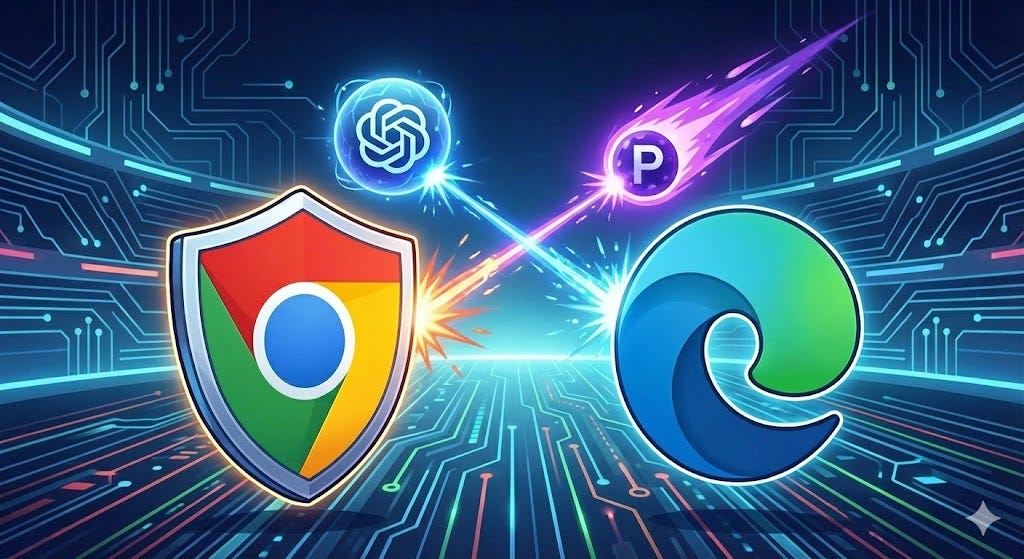
AI browsers are the new battleground. OpenAI (Atlas), Microsoft (Edge Copilot Mode), Google (Gemini in Chrome), and Perplexity (Comet) all shipped browser-native AI within weeks of each other –racing to capture the richest context stream in enterprise: what’s on your employees’ screens.
Most AI governance policies don’t address browsers. They should. Browser AI operates under consumer terms, not your enterprise agreements. Shadow AI detection can’t see it. And the more employees use it, the more context it captures.
Treat browser selection as an AI governance decision. Audit what’s deployed, disable ungoverned AI features on managed devices, and evaluate whether your enterprise AI stack competes at the context layer –or cedes it.
The Browser War Nobody’s Talking About - Lead Essay
While you were debating which LLM to standardize on, a quieter land grab happened in plain sight.
Late last month, OpenAI launched ChatGPT Atlas; a full web browser with ChatGPT built into its core. Two days later, Microsoft rolled out a major update to Copilot Mode in Edge. Google had already embedded Gemini into Chrome in September (and we can all see where Gemini is heading towards today, and moving forward…). Perplexity’s Comet browser went free to all users in October after launching to paid subscribers in July.
This was NOT a coincidence. It was a coordinated sprint for the most valuable real estate in enterprise AI: the context layer.
And most CIOs aren’t even watching.
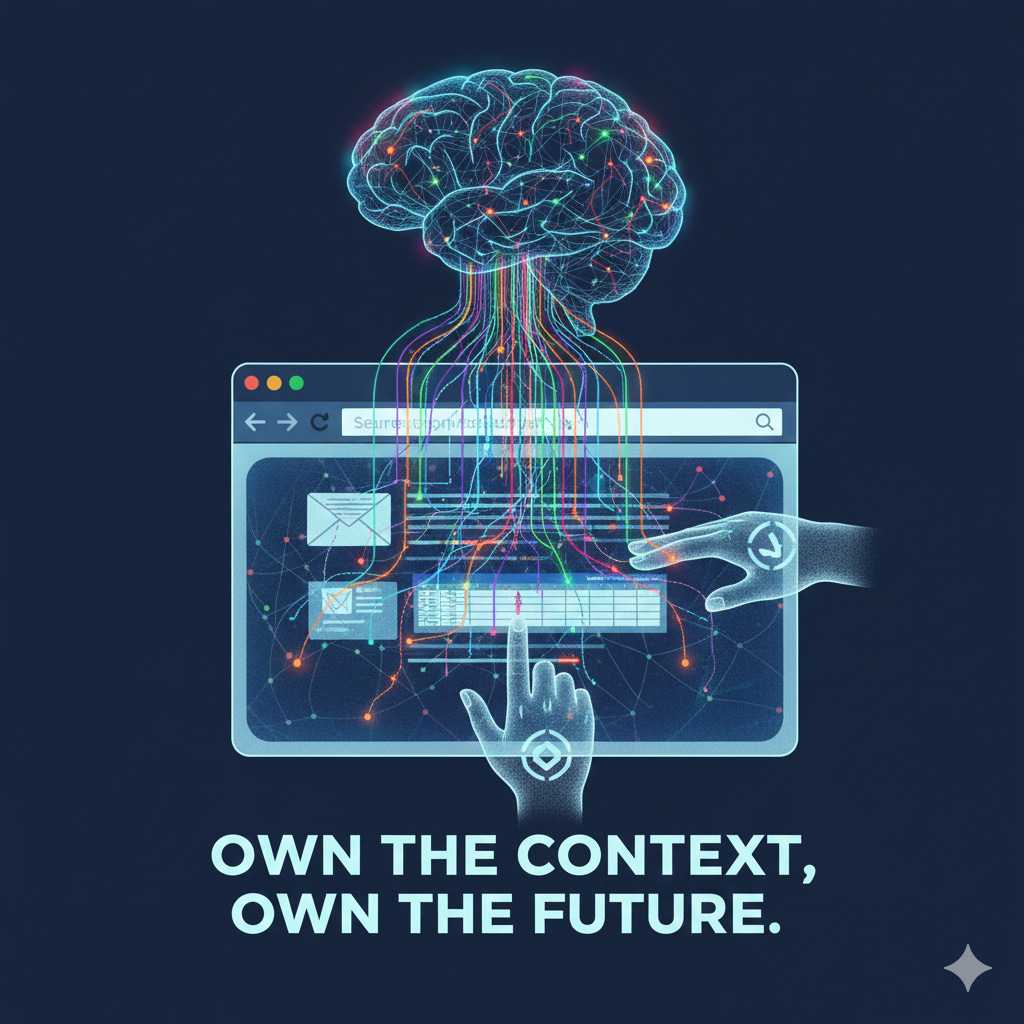
Here’s the reality: LLMs are only as useful as the context they can access. The richest, most continuous context stream available isn’t in your data warehouse or your CRM—it’s on your employees’ screens. Every tab open. Every email drafted. Every document reviewed. Every search query typed.
Browsers see everything. And an AI-native browser doesn’t just help you search –it observes.
Sam Altman was explicit about the stakes. At Atlas’s launch, he said this represents “a rare once-a-decade opportunity to rethink what a browser can be.” OpenAI’s announcement went further: “This launch marks a step toward a future where most web use happens through agentic systems.”
If you’re an executive who just spent six months locking down ChatGPT access, vetting AI vendors, and building governance frameworks for your enterprise AI stack, I have uncomfortable news: the browser your team uses every day may already be feeding context to AI systems you never approved.
The Products Are Real
OpenAI Atlas remembers context from sites you visit (”browser memories” stored for 30 days) and can take control of the browser to complete tasks via Agent Mode.
Microsoft Edge Copilot Mode reasons across your open tabs, organizes browsing history into “Journeys,” and at Ignite was positioned as “the world’s first secure enterprise AI browser.”
Google Chrome with Gemini analyzes up to 10 tabs simultaneously, integrates with Calendar/YouTube/Maps, with agentic task completion coming soon.
Perplexity Comet sets Perplexity as default search and can navigate the web on your behalf –clicking, filling forms, completing transactions.
These aren’t roadmap slides. They’re shipping products with hundreds of millions of potential users.
Why Browsers, Why Now
The browser wars of the early 2000s were about distribution. The browser wars of 2025 are about continuous context capture.
Consider what a browser knows about your workday: the emails you read (webmail), documents you review (Google Docs, Office 365), internal tools you access (dashboards, CRMs), research you conduct, and purchases you consider.
This isn’t metadata. This is the full texture of knowledge work. An AI with access to this stream doesn’t need you to write a prompt—it already knows what you’re working on and what you’re trying to decide.
The MIT Technology Review’s take on Atlas was blunt: “The real customer, the true end user of Atlas, is not the person browsing websites, it is the company collecting data about what and how that person is browsing.”
The browser is the last uncontrolled interface layer between users and AI. Whoever owns the browser owns the context.
The Enterprise Risk Nobody’s Discussing
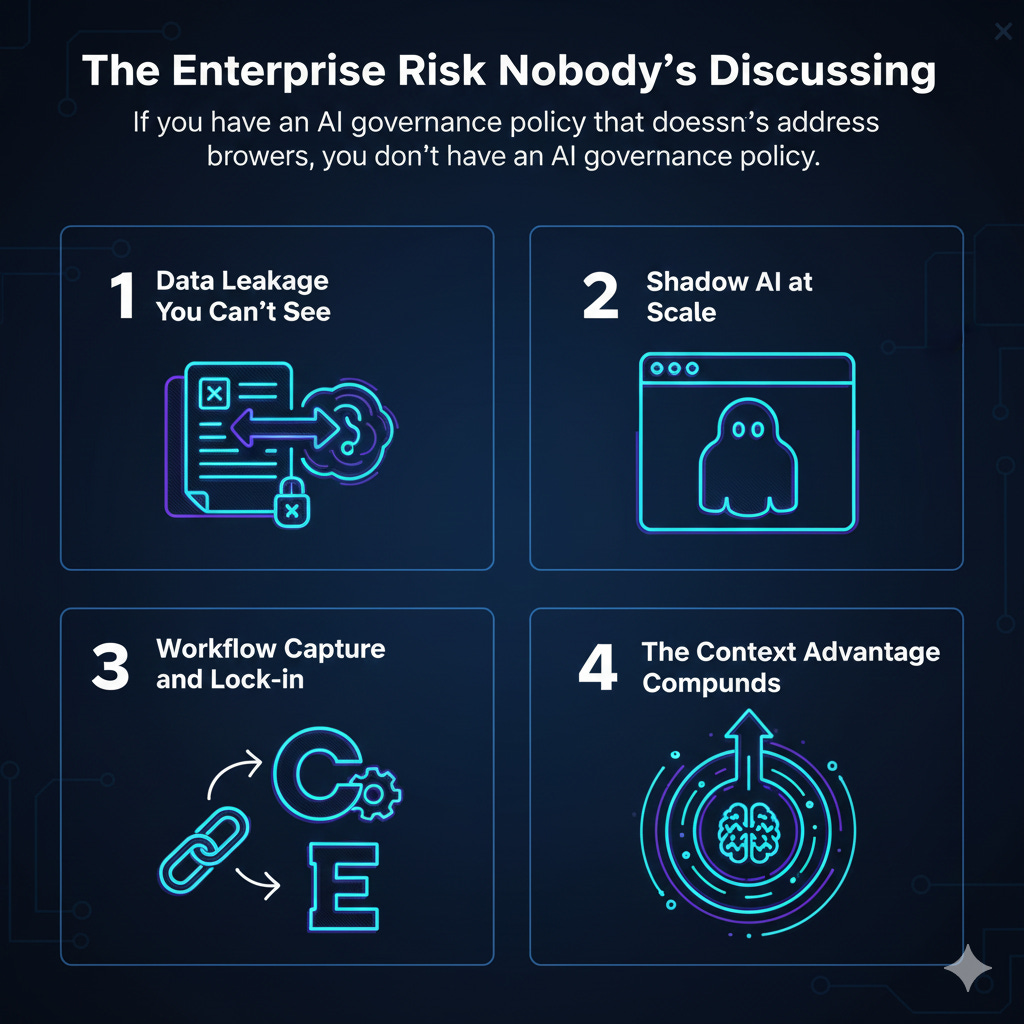
If you have an AI governance policy that doesn’t address browsers, you don’t have an AI governance policy.
1. Data Leakage You Can’t See
When an employee uses browser AI to summarize a document, where does that data go? Most browser AI features operate under consumer terms of service. The data handling provisions your legal team negotiated with your LLM vendor don’t apply to the AI summarizing a confidential deck in Chrome.
2. Shadow AI at Scale
Shadow AI in a browser is invisible. There’s no app to block, no URL to flag. The AI is part of the browser itself. Your employee isn’t “using AI”—they’re “using Chrome.”
3. Workflow Capture and Lock-in
Once employees get accustomed to browser-native AI, your sanctioned tools feel clunky. Why copy-paste into your approved AI when the browser does it with a right-click? Adoption of your governed AI stack drops –not because it’s worse, but because it’s slower.
4. The Context Advantage Compounds
The more context an AI captures, the more useful it becomes. The more useful, the more employees use it. This flywheel is already spinning. Every day without a browser strategy, someone else’s AI is learning your business.
What “Good” Looks Like
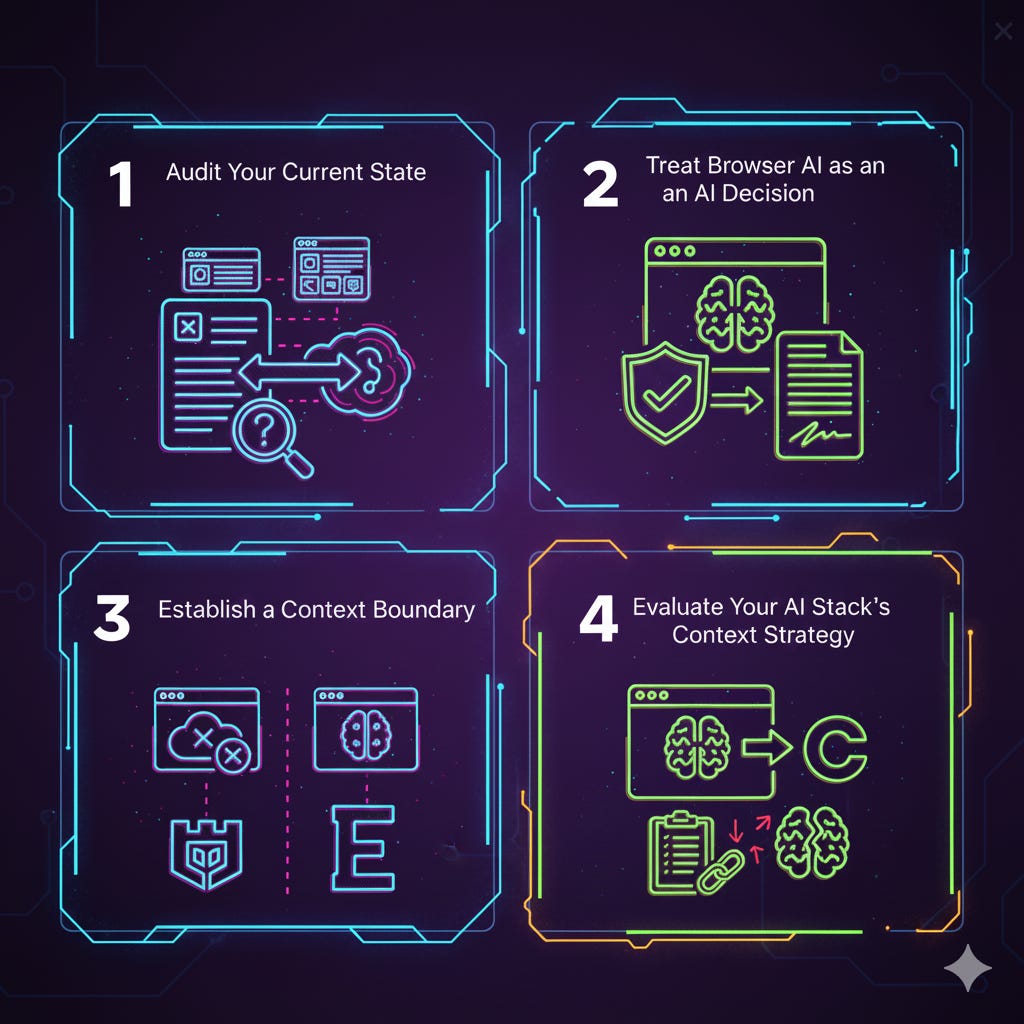
1. Audit Your Current State
What browsers are installed? What AI features are enabled by default? Most enterprises have no idea—browsers have been treated as commodity infrastructure. That assumption is now obsolete.
2. Treat Browser AI as an AI Decision
If a browser has built-in AI, it should go through your AI governance review. Add “browser AI capabilities” to your vendor security questionnaire.
3. Establish a Context Boundary
Decide what context you’re willing to share with browser AI versus your governed stack. This might mean disabling browser AI on managed devices or creating explicit policies about which tasks use which tools.
4. Evaluate Your AI Stack’s Context Strategy
If employees need to copy-paste to get value from your AI tools, you’re losing. The browser vendors understand that the AI closest to the work wins. Does your enterprise stack?
The Real Battleground
Everyone in your leadership team has an opinion about which foundation model to buy. OpenAI vs. Anthropic vs. Google vs. open source –these debates consume enormous energy and attention.
Meanwhile, the more consequential decision –who controls the interface between your employees and AI– is being made by default. Every time someone updates Chrome, installs Atlas out of curiosity, or enables Copilot Mode, the answer shifts a little further outside your control.
The browser is becoming the operating system for knowledge work. And the AI layer of that operating system is being built right now, mostly without enterprise input.
This isn’t a call for panic. It’s a call for attention. The executives who recognize that browser selection is now an AI governance decision –and act accordingly– will maintain control of their context layer. The rest will wake up one day to discover that their AI strategy has a browser-shaped hole in the middle of it.
The model wars make noise. The browser wars are where the context flows. Noise free means context aware. So cut through the noise; the signal is in your browser policy.
Which browsers are approved in your organization?
Have you audited their AI capabilities?
Reply directly –with your permission, I may feature insights in a future issue.
Noise Free Signal
Browser AI Governance Gap
Benchmark: Zero major enterprises had browser-specific AI policies before Q4 2025. Signal: If your AI governance doesn’t mention browsers, it’s incomplete.
Context Layer Control
Benchmark: 4 major AI browsers shipped within 90 days (July–October 2025). Signal: The race for context capture is moving faster than enterprise policy cycles.
Noise Free Intel (4 Worthy relevant links)
OpenAI: Introducing ChatGPT Atlas — The official announcement. Read what they’re actually claiming about browser memories and agentic browsing.
Microsoft Edge Blog: Edge for Business – The World’s First Secure Enterprise AI Browser — Microsoft’s Ignite announcement positioning enterprise controls as the differentiator. Worth reading for the gap it implies in consumer browsers.
MIT Technology Review: OpenAI’s New Atlas Browser — The sharpest critique of Atlas’s real purpose. “The true end user is the company collecting data.”
Go behind the browser with Chrome’s new AI features — Google’s September announcement embedding Gemini into Chrome. Note the “agentic capabilities coming soon” language (unless already edited).
Noise Free Q&A
This week’s prompt:
“Which browsers are approved in your organization? Have you audited their AI capabilities?”
Reply directly—with your permission, I may feature insights in a future issue.
Board-Ready Brief
You can download here (or click on the image below):

Thanks for earning your one-pager board-ready brief!