



Friendly disclaimer: images are curtesy of Gemini - please pardon spelling mistakes + all sources are provided in Noise Free Intel Section – enjoy!
Noise Free TL;DR
The loudest “AI bubble” voices are not AI skeptics. They are Legacy SaaS incumbents watching their business models collapse. Pay attention to who is singing.
Software is the bubble that just started popping... The S&P North American Software Index dropped 15% in January. Worst month since 2008! Jefferies traders are calling it the “SaaSpocalypse”
You’re probably paying for SaaS seats nobody is using because AI handles the work now. Audit per seat SaaS contracts before renewal season, not during it.
Only cost is your attention for the read. That said, I promise to make it worthwhile
Gold, Silver, Bitcoin, or AI: Wall Street is hunting the wrong bubble
Silver surged over 7%+ yesterday. Bitcoin is doing its thing, as it always does... Gold bugs and crypto traders are shouting about bubbles in every direction and blaming deleveraging for price action whenever it doesn’t sing along
Meanwhile, the actual bubble started popping. Quietly... And almost nobody’s paying attention!
The S&P North American Software Index just posted its worst January since October 2008. Down 15% in one month. SAP crashed 16%; ServiceNow dropped 11%; and they crushed estimates!! Thomson Reuters fell 16%; RELX, the legal analytics company, has nearly halved from its peak last February.
Jeffrey Favuzza works the equity trading desk at Jefferies. He’s coined a term/name for what’s happening: the “SaaSpocalypse”
His description of the mood? “Very much ‘get me out’ style selling.”
When he asks clients where their hold-your-nose level is, he told Bloomberg yesterday,
“even with all the capitulation, I haven’t heard any conviction on where that is. People are just selling everything and don’t care about the price.”This is not rotation. It is capitulation! And the people screaming loudest about an “AI bubble” are watching their own portfolios implode.

The bubble was never AI
For two years, legacy SaaS rode the AI hype. Every SaaS vendor slapped “AI-powered” on their product pages. Valuations climbed on promises of AI integration.
Well… Now, the receipts are due; and the math doesn’t work!
Here’s the thing: per-seat pricing assumes humans do the work. When AI agents handle 80% of CRM tasks, in many cases, paying for 50 Salesforce licenses at $300 a seat means you’re paying for 40 people who don’t exist. The model, simply, breaks.
Piper Sandler downgraded Adobe, Freshworks, and Vertex on Monday. Their reasoning?
“Our concern is that the seat-compression and vibe coding narratives could set a ceiling on multiples.”‘Seat compression’? I guess that’s the polite way of saying your pricing model is dying.
Thomas Shipp at LPL Financial (they manage $2.4 trillion) put it more directly: “The fear with AI is that there’s more competition, more pricing pressure, and that their competitive moats have gotten shallower, meaning they could be easier to replace with AI.”
‘Shallower moats’; ‘easier to replace’; isn’t that what extinction looks like before anyone calls it extinction?
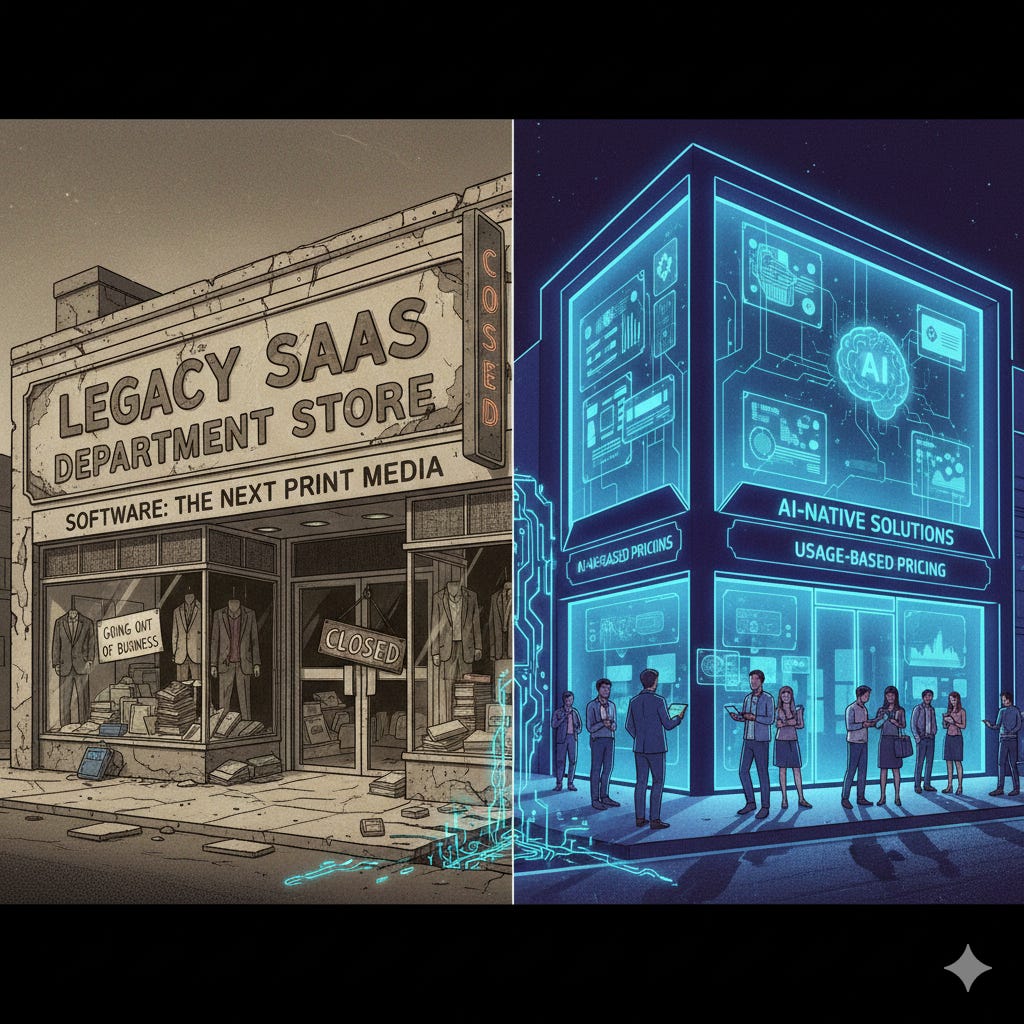
“Software will be the next print media”
The quote that stuck with me came from Favuzza:
“The draconian view is that software will be the next print media or department stores, in terms of their prospects.”Print media... Department stores.... industries that didn’t just decline; they became business school case studies about what happens when you don’t adapt.
Is that too extreme?!
Maybe…
But look at what happened this week;
Anthropic released a legal productivity tool that automates contract review, NDA triage, and templated legal responses. Within hours, legal software stocks cratered; RELX dropped 17%. That’s their biggest single-day decline since 1988!!
Alphabet rolled out Project Genie, which creates immersive video game worlds from text prompts. Video game stocks got crushed.
Every week, another category discovers it’s not an “AI beneficiary.” It’s an AI target.
The denial is louder than the data
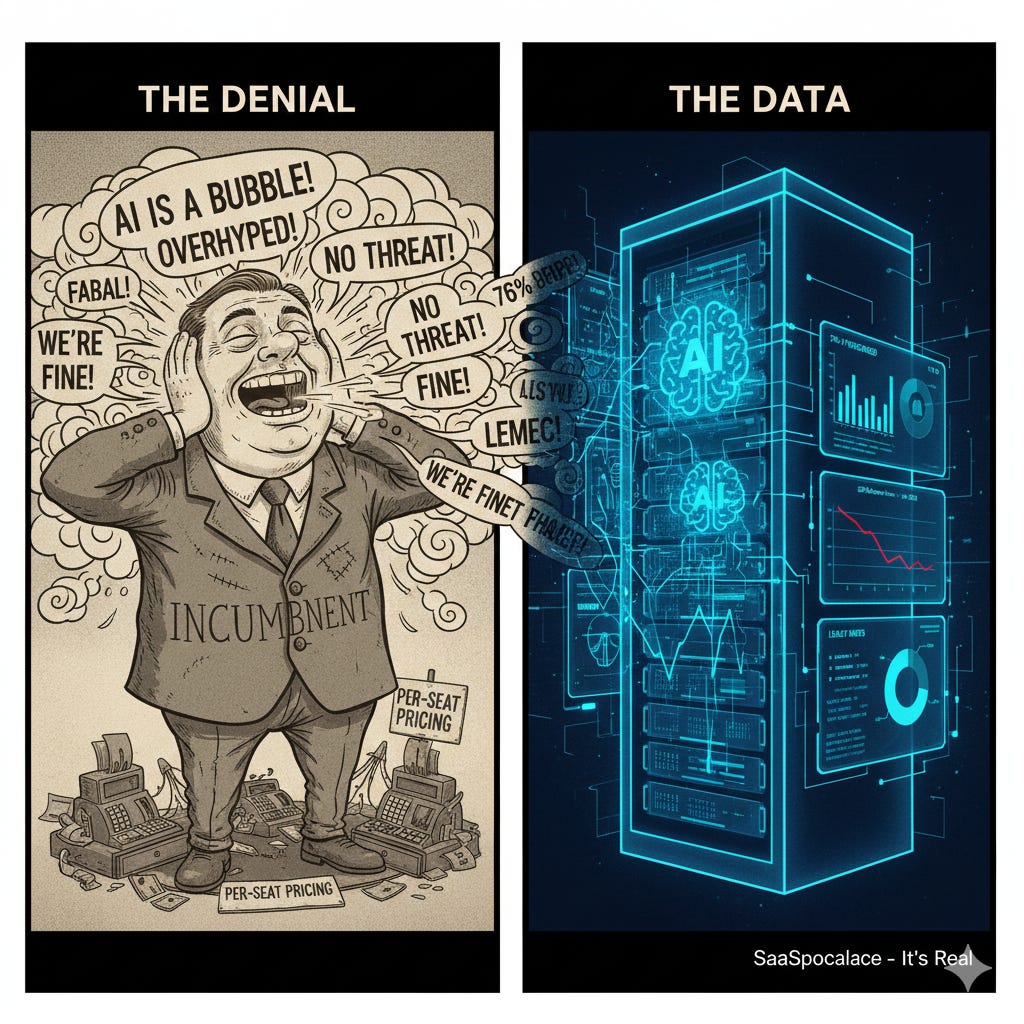
Here’s what I find interesting: the loudest “AI bubble” voices aren’t coming from skeptics. They’re coming from incumbents.
Seventy percent of software providers now admit that delivering AI features is eating into their margins*. The “infinite margins” legacy SaaS era is over. Companies like Salesforce and Adobe are scrambling to pivot from per-seat subscriptions to usage-based pricing. Not because they want to. Because their cloud bills are ballooning as customers are demanding it, hence the economics forcing it.
When a legacy SaaS vendor tells you ‘AI is overhyped’, ask yourself: what’s their pricing model? What’s their moat? What happens to their valuation if seat counts drop 40%?
The bubble narrative is convenient when your business model is the actual bubble.
Private equity firms get it; Arcmont Asset Management and Hayfin Capital Management are hiring consultants to audit their portfolios for AI-vulnerable businesses. They’re not debating whether AI is a bubble. They’re mapping which assets will survive, and pretty much how to go about it from this point forward… pretty much an irreversible change
The decision you need to make
If you’re a CEO, CIO, CFO, or COO, here’s the question I invite you to honestly ask: how many seats are you paying for that AI has already made redundant?
I know this touches something uncomfortable. Many of us are quietly avoiding questions that lead back to jobs, whether directly or indirectly. But here’s the reality we find ourselves in: you’re probably adopting AI faster than you expected. Headcount is shifting; some roles are being cut; others repurposed. That is already happening, whether we talk about it openly or not.
What often gets missed in that conversation is the legacy SaaS/Software side; you’ve adjusted the team, but you’re still paying for licenses sized for the old team.
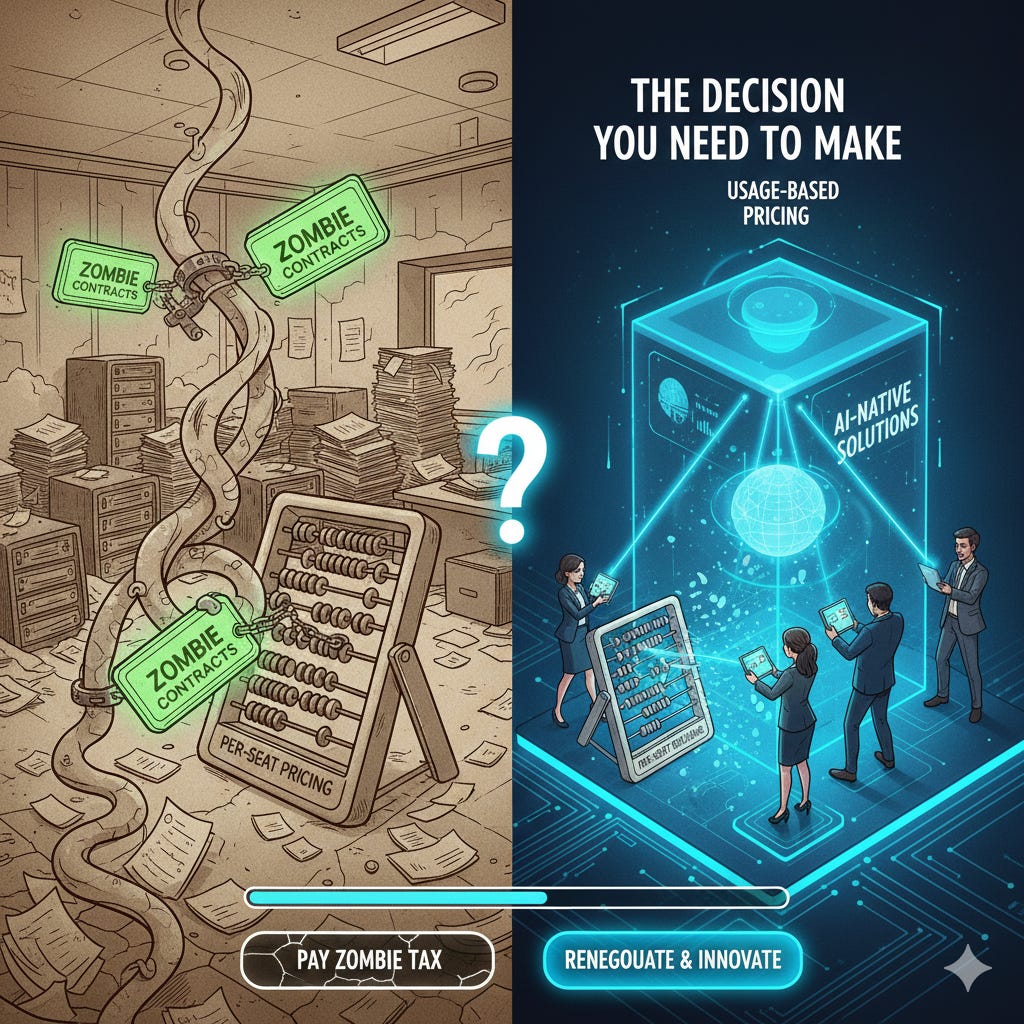
I call these zombie contracts! Licenses on your books for work AI now handles. Every enterprise has them. Most enterprises haven’t looked yet.
Here’s a simple way to think about it:
Start by listing every per-seat SaaS contract renewing in 2026; e.g: Salesforce, ServiceNow, Adobe, Workday, SAP, etc… Anything charging by headcount.
Then score each one for AI substitution. Ask: what percentage of the work this tool supports could an AI agent handle today? (YES! TODAY; Not in two years!). If the answer’s over 50%, then you’ve got a zombie you need to deal with.
Calculate your phantom seat count. A hundred licenses where AI handles 60% of the workload means you’re paying for 60 people who aren’t there.
Renegotiate or replace before renewal. Challenge vendors toward usage-based or outcome-based pricing. If they won’t move, look at AI-native alternatives.
The companies that do this audit in Q1 will negotiate from strength. Everyone else pays the zombie tax.
The bottom line
Gold is volatile; Silver’s whipsawing; Bitcoin does whatever Bitcoin does, but if you’re looking for a bubble, stop watching the assets making headlines. The bubble that matters to enterprise leaders is in your software portfolio. Contracts built on assumptions AI is breaking right now.
The S&P Software Index just had its worst month since 2008. Traders are calling it the SaaSpocalypse. Private equity is auditing for casualties.
The vendors telling you to slow down AI adoption are hoping you won’t notice their business models are what is actually overvalued.
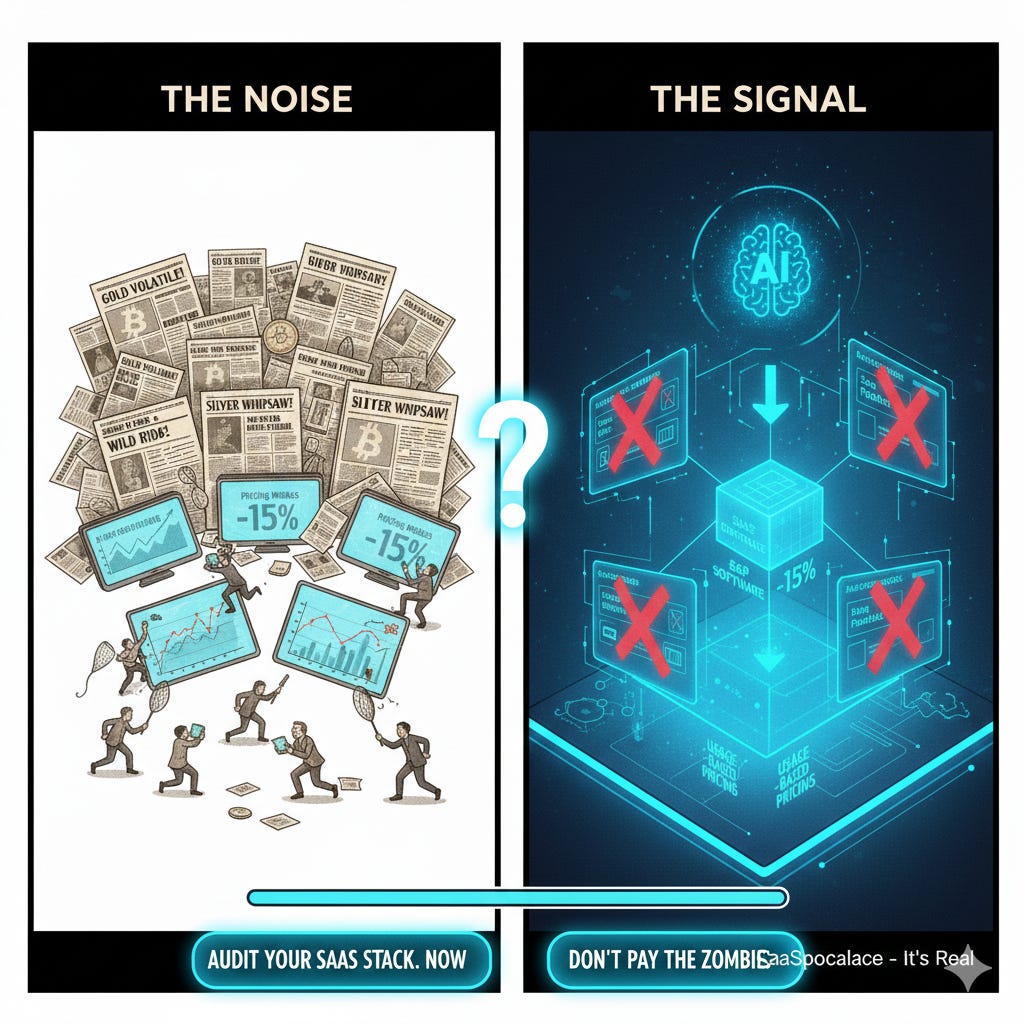
I think we can all agree that it’s so easy to get lost in the noise of headlines, especially when trillions of dollars get wiped in a matter of days across commodities and crypto; yet I would argue that none of that is new, much of it is history repeating itself. What you need to notice is the signal within this noise; the real structural changes in the market and offerings that affect your day-to-day operations and P&L.
Follow the Signal; do not slow down; speed up the audit! Stay noise free.
Noise Free signal
Metric of the week
S&P North American Software Index: down 15% in January 2026. Worst monthly performance since October 2008.
The market isn’t debating whether AI disrupts software. It’s pricing it in.
Seat compression is real
76% of enterprise AI use cases are now purchased, not built (up from 47% in 2024). Enterprises are buying AI faster than legacy vendors can adapt their pricing.
Source: Menlo Ventures State of Generative AI 2025
Noise Free intel
1. Bloomberg: “’Get me out’: Traders dump software stocks as AI fears erupt” The source for this week’s lead. Jefferies coining “SaaSpocalypse” and the 15% January crash are the data points your board should see.
Bloomberg/Yahoo Finance, Feb 3, 2026
2. Piper Sandler downgrades Adobe, Freshworks, Vertex Analyst Billy Fitzsimmons cited “seat-compression and vibe coding narratives” as ceiling risks. Translation: per-seat models are structurally impaired. Feb 3, 2026
3. Anthropic legal tool triggers RELX 17% crash One product launch sent legal analytics stocks into freefall. RELX had its worst day since 1988. Thomson Reuters down 16%. This is how fast disruption happens now. Feb 4, 2026
4. PE firms auditing portfolios for AI vulnerability Arcmont and Hayfin are hiring consultants to assess AI exposure across their holdings. When private equity runs scared, pay attention. [Bloomberg, Feb 3, 2026]
5. Menlo Ventures: State of Generative AI 2025 The definitive data on enterprise AI spend ($37B in 2025, 3.2x YoY growth) and the buy-vs-build shift. Required reading for anyone setting 2026 budgets.
[BONUS] Leader Q&A
Q: “My CFO keeps asking if AI is a bubble. How do I respond?”
Ask which bubble they mean. If they’re worried about AI infrastructure valuations, that’s a reasonable conversation about timing and multiples. But if they’re suggesting the company should slow AI adoption, point them to the software index. Down 15% in January. Worst month since 2008.
The market isn’t pricing an AI bubble. It’s pricing a legacy SaaS bubble.
The vendors screaming loudest about AI being overhyped are the ones whose business models are breaking. Your job isn’t to time the AI market. It’s to make sure your organization captures value before competitors do.
Audit your Legacy SaaS stack; not your AI roadmap.
Board-Ready Brief (1-Pager Summary)
You can download here (or click on the image below)
